Rooms
Reading, Writing, Media, and Poetry Workshop
In our reading, media, and writing workshop, we invite children to discover language, stories, images, and writing through play. As they look at picture books, listen to stories being read aloud, and tell their own stories, they are given space for their own thoughts, questions, and imagination. Together, we explore poems, rhymes, and language games; listen to the sound and rhythm of language; and create our own verses. We explore various media together and use them creatively. Using a camera, the children capture their own discoveries, look at their pictures together, and use them as inspiration for storytelling or to create their own picture stories. Using a variety of materials, the children can try their hand at their first drawings and letters, leaving their mark—without any pressure to perform. We support them according to their interests and developmental stage and incorporate their family languages. The goal is to spark a joy for language and expression, as well as to enable self-directed learning and collaborative creation.
Role-Play Room
In the role-play room, children can explore and recreate their world through play. They develop imagination, creativity, and self-confidence—whether at the play store, in the doctor’s office, in the play kitchen, with puppet shows, shadow plays, or acting out scenes. Children can take on different roles and characters, act out everyday situations, invent their own stories, and put on little performances. In the process, they learn to express their feelings and thoughts, empathize with others, and work together to bring their ideas to life. Children experience everyday routines in a playful way, and at the same time, their language, social, and emotional skills, as well as their independence and sense of community, are strengthened.
Building/Construction Room
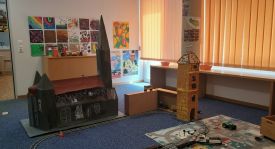
The construction room offers children a wide range of opportunities to develop their creativity, imagination, and spatial awareness. By independently planning, building, and constructing with various materials, children develop their fine motor skills, problem-solving abilities, and foundational understanding of mathematics and science. In addition, children strengthen their independence, perseverance, and social skills by working together to develop ideas, find solutions, and design their structures.
Science and Ecology
In this area, children are encouraged to explore their environment with all their senses. They observe natural phenomena and, through their own experimentation, begin to understand basic scientific concepts. They develop an awareness of the diversity and value of nature and learn to use natural resources thoughtfully, as well as to take responsibility for their environment.
Art Studio
In our art studio, aesthetic education is much more than just painting pictures or learning about colors and shapes—above all, it means discovering the world with all the senses. Through creative design, children gain new experiences, develop their own ideas and insights, and can express their perceptions in a variety of ways. We view creativity as a creative skill that we value and nurture on an individual basis.
pace for Movement
"Through movement, the child enters into a dialogue with its environment; movement connects its inner world with its outer world. The world reveals itself to the child through movement. Step by step, the child takes possession of it. With the help of physical and sensory experiences, the child forms concepts; through interaction, it learns about and comes to understand cause-and-effect relationships. Thus, the kinesthetic senses—the sense of balance, the sense of touch, sight, and hearing—provide the child with many impressions of its environment and of itself in relation to it. Grasping is always also a form of understanding; taking hold is a form of comprehending. Even before a child can express itself through language, it already acquires knowledge of spatial relationships, and it gains this knowledge through experiences involving perception and movement, in which these connections become apparent.” Prof. Dr. Renate Zimmer
Movement is fun and promotes health. Whether climbing, running, jumping, dancing, or doing yoga: diverse forms of movement stimulate imagination and creativity. They appeal to children of all ages, allowing them to fully express their natural joy of movement and to convey their thoughts and feelings.
A variety of physical activities supports healthy posture and good body awareness. It improves coordination, concentration, and perception; strengthens self-esteem; and simultaneously promotes motor skills, social interaction, and emotional balance.
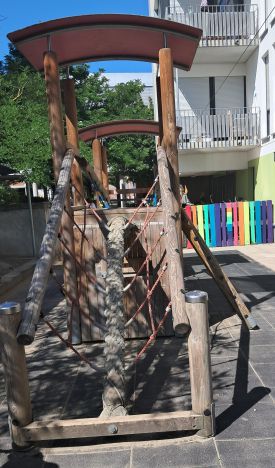
Even young children explore their surroundings through movement. They crawl, run, climb, jump, balance, or move rhythmically to music—spontaneously, curiously, and joyfully.
Climbing, running, yoga, jumping, balancing, and dancing cater to children’s natural urge to move. Moving together fosters social connections and can strengthen them.
The Garden as a Space for Learning and Experience
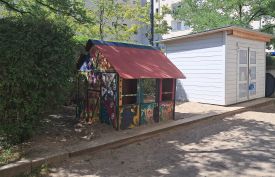
The outdoor area offers a unique range of learning opportunities that are not possible indoors. Sensory experiences: Children can explore natural materials such as wood, stones, water, sand, and plants with all their senses. This sensory diversity promotes perception and both fine and gross motor skills
Experiencing Nature: Direct contact with nature enables children to independently discover and understand environmental processes (e.g., plant growth, weather phenomena). A well-designed garden supports children’s holistic development.
Independent Activity: Children can explore their environment on their own, which strengthens their sense of self-efficacy and problem-solving skills.
Projects and Daily Life: The garden serves as a space for hands-on activities such as gardening, sowing, and harvesting (e.g., radishes or herbs), which fosters an understanding of food production and sustainability.
Modern spatial designs aim for a seamless connection between the group room and the garden. Through large windows or open doors, materials and activities can move back and forth depending on weather conditions and educational needs.
The use of natural materials (wood, plants) characterizes both the indoor and outdoor areas and creates a unified, calm aesthetic that invites children to linger.
The Daycare Center—a Safe Place to Belong and Grow
The U3 Room is the “nest” for the youngest children in our center.
Our nursery is a safe and stimulating educational and living environment for children under three years of age. In a loving, supportive atmosphere, we provide attentive care for each child, focusing on their individual needs, interests, and unique pace of development. Recurring rituals, consistent caregivers, and a child-friendly room design provide a sense of security and lay the foundation for children to increasingly explore their environment independently.
Our educational approach builds on the diverse experiences and forms of expression of our youngest children. Through free play, physical activities, singing and storytelling together, creative projects, and exploring materials and nature, the children gain important experiences that support their physical, linguistic, emotional, social, and cognitive development. In the process, their cues and interests are noticed, addressed, and used as a starting point for individual learning processes.
The nursery works closely with the section for three- to six-year-olds in the same building. Through shared interactions, cross-group activities, familiar spaces and materials, and collaboration among the educational staff, the children experience the facility as a cohesive living and learning environment. Older and younger children can interact with one another, learn from each other, and form their first relationships, without losing sight of the needs of their respective age groups.
The transition from the nursery to the section for three- to six-year-olds is handled gently and in a participatory manner. The children gradually become familiar with their future spaces, caregivers, and daily routines, allowing them to prepare for the change at their own pace. A trusting partnership with families, along with ongoing coordination within the educational team, ensures that this important developmental step provides a sense of security and enables a smooth transition into the new group.