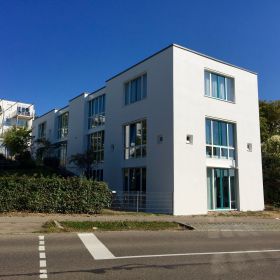
Kita Ochsensteige 6

3 Jahre bis Schuleintritt

Address
Kita Ochsensteige 6
Ochsensteige 6
89075 Ulm
Funding authority
Stadt Ulm
Zeitblomstraße 7
89073 Ulm
ochsensteige@ulm.de
https://abteilung-kita.ulm.de
0731 161 8490 (Jessica Jahn, Amelie Held)
Opening times7:15 AM - 5:00 PM o'clock
Closing days30 Tage im Jahr, davon 15 Tage im August
Foreign languages English, Turkish
Specially educational concept daily routine language education, infans, open concept, open work
Extras Care with lunch, Integrative facility, Pets, full day care, language education
Pets Stabschrecken

Current information

Welcome

We’re glad you’re visiting us! Here you’ll find an overview of our municipal daycare center, our educational approach, and everything you need to know about daily life at the daycare. We look forward to getting to know your family through this platform.

If you’re interested, you can send an inquiry directly to our center by clicking the “Submit a Care Inquiry” button.

We look forward to meeting you.

Introduction/specifics

The Ochsensteige 6 Municipal Daycare Center is a facility for children ages 3 through school entry and has space for 40 children. Our center spans three floors and features a large garden area. Our educational approach is based on the infans early childhood education concept. Our facility offers your children learning spaces where they can develop and grow in individual and diverse ways, guided entirely by their own interests.

Our Care Hours:

We offer two care packages to provide a suitable solution for every family. Within the respective care hours, parents are free to pick up their children earlier—it is not necessary to use all the allotted hours.

Care Package 4

Monday through Friday: 7:30 a.m. – 4:00 p.m.

Hours per week: 42.5 hours

Care Package 5

Monday through Thursday: 7:15 a.m. – 5:00 p.m.

Friday: 7:30 a.m. – 4:00 p.m.

Hours per week: 47.5 hours

Rooms

The facility uses an open-structured space concept that enables children to act independently, explore, and pursue their own interests. Various activity rooms support a wide range of learning processes:

In the building room, children build, construct, and experiment—in the process developing spatial awareness, problem-solving skills, and fine motor skills.

The creative room invites children to paint, do crafts, weave, and design, offering space for aesthetic education and creative expression.

The movement room is available for obstacle courses, movement games, and other activities, supporting motor development and a love of movement. The music cabinet, filled with many different instruments, invites children to sing and make music together.

The role-play room and the theater room give children the opportunity to reenact everyday situations, take on different roles, and further develop social, emotional, and language skills through free play. Board games and puzzles are also available there.

The materials in the experiment room encourage children to explore and discover on their own. Additionally, hands-on experiments are conducted there.

Outdoor Facilities

Our facility has an outdoor area located behind the building that spans two levels. On the lower level, there is a sandbox, a balance beam, a climbing frame, space for riding toy vehicles, and a large stone staircase where children can rest and regain their energy. The upper level, which is connected to the lower level by a slide, offers your children a swing set, a water play area, and a playhouse.

Of particular note is the ample shade provided by large chestnut trees during the summer.

Daily Schedule

Daily Schedule

The day at our center follows a reliable structure while also giving the children room for self-directed activities. Scheduled activities alternate with open periods during which children can pursue their own interests.


7:15 – 9:00 a.m.

Drop-off & Arrival – The children are welcomed in a calm atmosphere and can start free play right away.

7:30 – 9:00 a.m.

Breakfast – Breakfast takes place on a flexible schedule. The children decide for themselves when and if they would like to eat breakfast.

9:15 – 9:30 a.m.

Morning Circle – Our morning circle is a fixed part of the day.

Starting at 9:30 a.m.

Free Play, Activities & Programs – The children use the various activity rooms and the outdoor play area

11:15 a.m. – 1:00 p.m.

Lunch – The children decide for themselves when they would like to eat.

1:00 p.m. – 2:45 p.m.

Free Play, Activities & Programs – The children use the various activity rooms and the outdoor play area.

2:45 – 3:00 p.m.

Afternoon snack – Group snack time

3:00 – 5:00 p.m.

Pick-up time & free play – The day winds down in a calm atmosphere.

Food

Breakfast: The children are provided with a balanced breakfast, which we prepare fresh every day. They can choose from breakfast cereals with milk, bread, cheese, vegan sausage, butter, cream cheese, fruit, and vegetables. Breakfast is served daily between 7:30 a.m. and 9:00 a.m. During this time, each child can decide for themselves if and when they would like to eat.

Lunch: Our hot lunch is delivered daily by Gasthaus Lamm in Blaubeuren/Asch. Since independence and self-determination are important to us, your children can decide for themselves when they’d like to eat. The designated time frame is between 11:15 a.m. and 1:00 p.m.

Afternoon Snack Break: At 2:45 p.m., we offer a small snack. This usually consists of yogurt, fruit salad, or crispbread.

In addition, fresh fruits and vegetables are always available for your children in our snack corner.

Care providers are responsible for all profile content. (State: 13/11/2026 13:08:47)

Basics

The foundations of educational work in the city’s child care centers are:

• The infans Action Plan for Early Childhood Education

• The revised Orientation Plan for child care centers and family day care in Baden-Württemberg

“The child is the architect of his or her own development.”

Quote from Maria Montessori—educational reformer

The City of Ulm incorporates this fundamental educational philosophy into its daycare centers and, through the infans Action Plan for Early Childhood Education, places the children’s individual educational processes at the center of its approach.

Core elements of the concept:

Educational professionals observe and reflect on what is important to each individual child and which topics are currently engaging the child. These observations are documented in the child’s portfolio. Based on this, the professionals develop individualized challenges for each child in accordance with their educational interests and topics. In this way, the child is supported in their learning process.


The daycare center’s team develops educational goals and integrates them into their pedagogical practice. In this way, cultural concerns as well as the priorities of the sponsoring organization, parents, and educators are also conveyed to the children. 4 The observations and educational goals form the foundation of the educational work.

Detailed information can be found at www.infans.de.

Based on the infans action plan for early childhood education, the orientation plan is implemented at a high professional level.

Qualification

The ongoing development of our educational work is a top priority for us. Weekly team meetings provide an opportunity for professional exchange, reflection on educational practices, and collaborative development. Existing processes are continuously reviewed and adapted to meet the needs of the children and their families.

In addition, our staff regularly participate in continuing education and professional development courses as part of the city’s training program.

Additional Offerings

Our daycare center works closely with a special education teacher from the Family Support Service of the City of Ulm’s Department of Social Affairs.

She serves as the point of contact for the teaching staff and parents and is available to provide advice and support.

Together, we guide and support children according to their individual needs and developmental levels. The goal is to strengthen each child’s development, foster their abilities, and enable them to participate equally in daily life at the preschool.

Support is integrated into daily routines as much as possible and provided together with all the children. Through regular communication and close collaboration between the special education teacher, the teaching staff, and parents, we create a supportive environment where every child is welcome and can thrive to the best of their ability.

Teamwork with school

An important part of our work is our close collaboration with Merian Elementary School. The transition from preschool to elementary school is a significant step in a child’s life—one that we aim to make as positive and supportive as possible, working together with the school. Through this partnership, we want to help ensure that every child starts this new phase of life well-prepared and receives the appropriate support early on, as needed.


A liaison teacher is an integral part of this partnership. The following activities take place as part of the partnership:


•    Supporting the transition from daycare to elementary school
•    Exchanging information and providing consultation with the daycare center
•    Conducting classroom observations and activities at the daycare center
•    School visits for preschoolers

Teamwork with parents

Collaboration with families is very important to us. We view supporting the children as a shared responsibility—and therefore maintain an open and regular dialogue with parents. Casual conversations throughout the day, as well as regular developmental meetings, give parents ongoing insight into their child’s development.

Once a year, we hold a parents’ evening to discuss current topics and share information about the center. In addition, we invite families to actively help shape life at the daycare—whether through celebrations or special events like Storytime.

The Parent Advisory Board plays a vital role as a bridge between parents and the center. During regular meetings, we discuss concerns, requests, and organizational matters together.

Specifics

Our educational work is guided by the children’s needs and interests.

Intercultural Education

Our center is characterized by great cultural and linguistic diversity. Children from different backgrounds play and learn together here—this enriches their daily lives and fosters mutual understanding. Through dialogue with families, various customs and traditions are incorporated into our educational work. For us, intercultural education is not an add-on, but a natural part of our daily work.

We also collaborate with the IB Speech Therapy School in Ulm. Once a week, students from the school visit and conduct language activities with selected children.

Preschool Project

Two specialists from our team support the preschoolers during their final year to prepare them for school. Activities and projects take place regularly. The children also attend theater performances, visit playgrounds, and go on field trips, such as to the weekly market or to Friedrichsau. Through the preschool project, the children feel a sense of belonging to their group, experience a sense of community, and gain initial insights into areas such as reading and math.

Special Collaboration/Inclusive Education

Our facility works closely with the City of Ulm’s Family Support Service. At regular intervals, we receive support and guidance in our daily routine from a special education teacher. She is available to us with advice and support.

Care providers are responsible for all profile content. (State: 13/11/2026 13:08:47)

Description and Stations

Our daycare center is located in Ulm, on Eselsberg. You can reach us by taking bus line 5 and getting off at the Eselsbergsteige stop. Walk about 300 meters uphill, and you’ll find us on the right.

Care providers are responsible for all profile content. (State: 13/11/2026 13:08:47)

Maps are displayed only if you accept the corresponding cookies.
enable map